
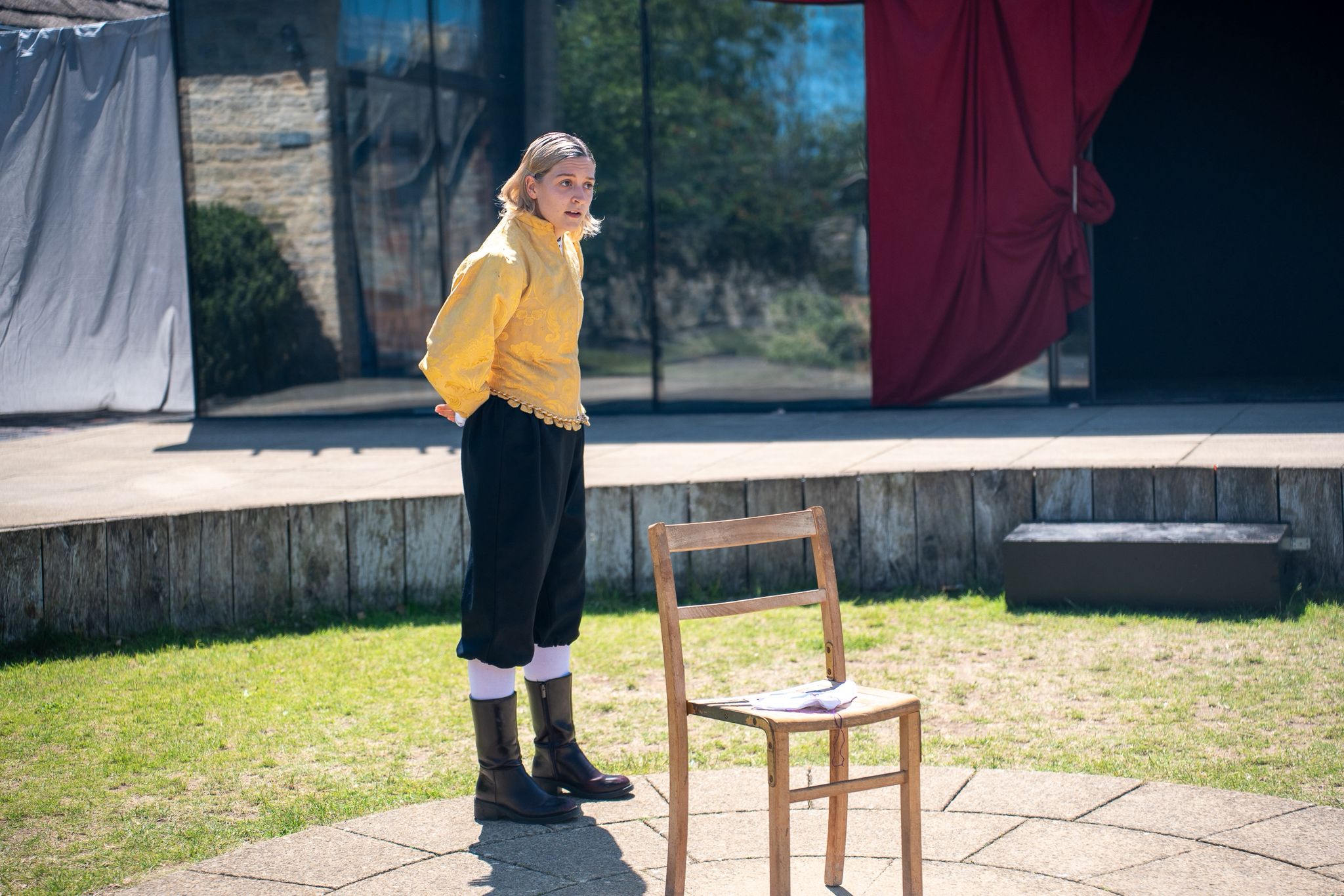
The casting process is much like an application for any job. In order to be considered one must fit certain criteria that make them eligible for the role. For a job this can be qualifications such as degrees or skills. In casting, however, this can often include certain looks and styles, things like height, eye colour etc. that go beyond one’s control. A category that falls into that is gender identity. Imagine how strange it would be to be a trained chef but be turned away because you look like a woman and the person hiring had a male presenting chef in mind. It’s an oversimplification but it highlights the difficulty non-binary performers are facing in the world of casting. The casting system as it currently exists structurally disadvantages non-binary performers because the gender that someone most resembles is treated as a fixed employment condition.
Orlaigh’s story
Orlaigh is 24 and a young actor going into their final term at drama school. That phase of the course is the culmination of three years intensive training and the point when an actor is first revealed to the wider industry. From a training environment built around gaining as many varied experiences as possible a more objective conversation emerges about casting types, agencies and clashes on their books. People are categorised often on the basis of appearance and that reflects the visual nature of the performance industry.
For a lot of students, it can be an affronting moment but for students such as Orlaigh it can be far more complicated. This is because Orlaigh identifies as non-binary, an adjective used by people who experience their gender identity and/or gender expression as falling outside the binary gender categories of ‘man’ and ‘woman.’ However, Orlaigh put it more simply – “you can’t put, like, a label on it”.
Regardless of definition it is important to note that the non-binary population is very small. The 2021 census of England and Wales found that only around 30,000 people aged 16 or over identified as being non-binary. For reference that is the capacity of Ipswich town FC’s stadium Portman Road. Despite increases in numbers over the last few years being non-binary puts Orlaigh in a minority of a minority.
Drama school and beyond
Throughout drama school Orlaigh has felt “lucky with opportunities of being able to play male characters and female characters” with roles ranging from Eurydice in Eurydice to Laertes in Hamlet. However, when asked about their professional prospects the outlook was less diverse stating that “the only jobs that [they] probably will get is female roles”. They feel this is because of the way they appear and that the “talent side of it is at the lower end of the spectrum and it is all to do with how you look”.
Orlaigh identified that should they want to play male roles the expectation would be that they go through gender-affirming hormone therapy and that is something they admitted to having considered, primarily for personal reasons, but it would have left them in a difficult position on the flip side. If they wanted to play female roles, they would have to go through the long and sometimes difficult physical/hormonal transition again and for every alternately gendered part they receive. This is unhealthy and unfeasible.
The problems and possible solutions
Looking forward, Orlaigh had some thoughts that struck into the heart of the issue. They suggested that audiences aren’t familiar enough with a person with feminine features playing and being a male character and would often come away saying “what’s that woman doing playing a man?” Orlaigh surmised that this was as a result of society being conditioned to a binary system of gender and had some ideas of how that could be changed.
“Adverts. There is still a surprise when you see [non-binary] characters in an advert” and “It’s still revolutionary for some reason”. They said that “if they make it more regular, they make more interesting non-binary characters in adverts” people would become more accustomed to seeing non-binary people in everyday media. Eventually Orlaigh hopes it would “just be as if you’re watching a man and a woman”.
Industry insight
If non-binary characters start appearing in our adverts, the media we regularly consume, films and TV then maybe the industry would do away with the archaic casting principles that have restricted non-binary performers, however, in order to do this, they need to be cast in the first place. It’s a bit of a chicken and egg and doesn’t seem to be coming round the corner any time soon.
When the Actors’ Equity Association (The US Labour Union) published its ‘Hiring Bias and Wage Gap Report’ report in 2025 it found that the percentage of overall contracts given to non-binary performers fell from 2% in 2016-2019 to 1.6% in the period of 2022-2023. When the percentage share is as small as it is a decrease of 0.4% is significant and a marked turn in the wrong direction. Furthermore, it found that even those who got work were being paid between $98.68–$295.54 less, over the course of their contracted term, than their male and female colleagues.
There is still plenty to be done to find true fairness in the performance industry for non-binary actors and whether the solution is in adverts, casting, or hasn’t yet revealed itself, we should all be working towards finding one. That starts with conversations with people like Orlaigh and with confronting our attitudes to gender in performance art.
–
16th March 2026
–
Leave a Reply