
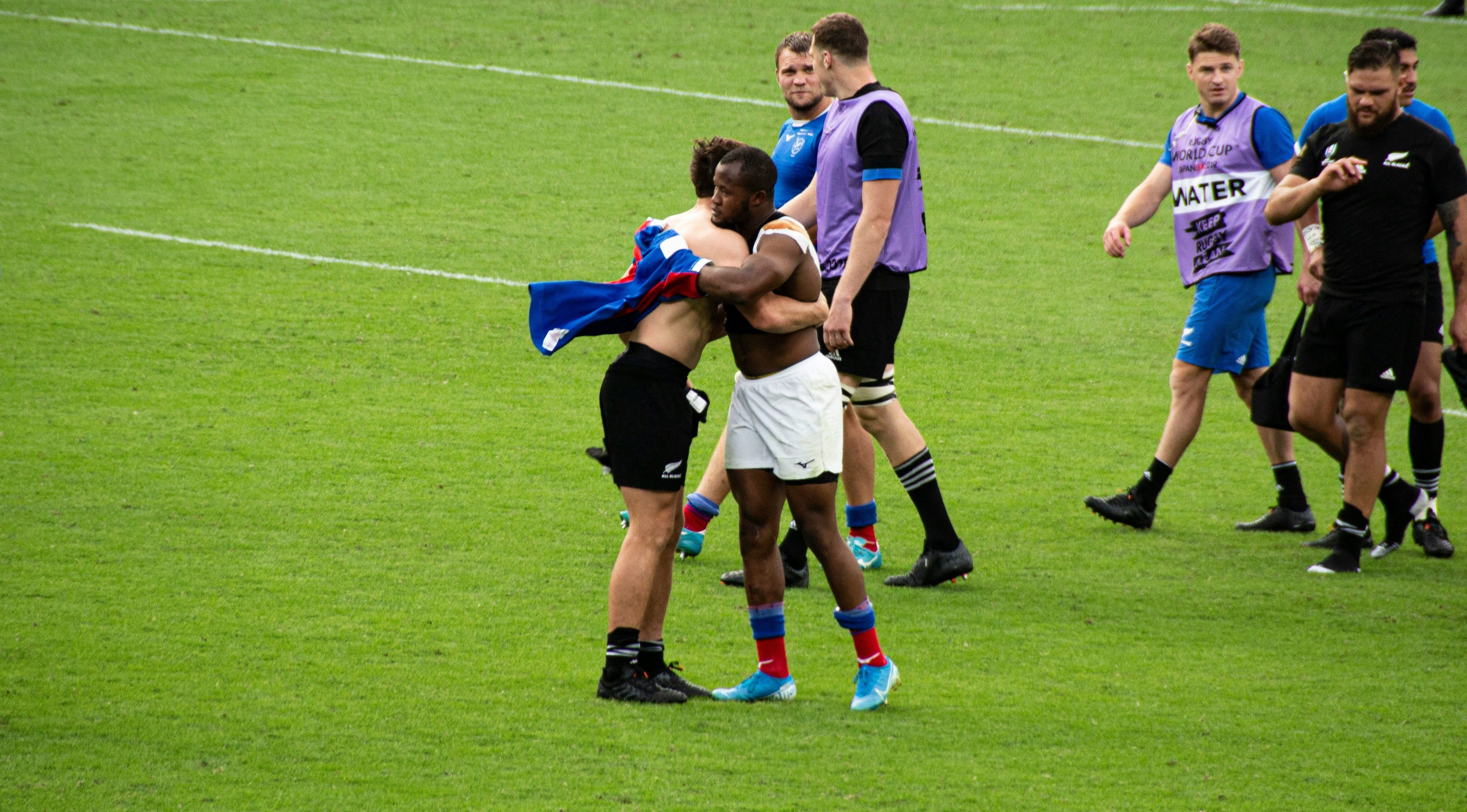
On the 5th of December 2025 Donald J Trump received the FIFA Peace Prize. On the 1st of May 2026, at the FIFA Congress in Vancouver, CEO Gianni Infantino attempted to orchestrate a handshake between Israeli and Palestinian delegates. On the 9th of June 2026 Somali referee Omar Artan arrived in Miami in preparation for being the first Somali referee at the World Cup Finals.
Three examples of sport bringing people together. Right?
However, 85 days after the peace award, Trump’s administration ordered the military to strike Iran for the first time. The handshake between the Israeli and Palestinian delegates failed. After 11 hours in immigration Omar was denied entry to the US and was taken off the referee list for the tournament.
Now on the eve of what was sold by FIFA as the “most inclusive” World Cup ever, the question is: does sport bring us together, or push us apart?
Apart
Despite often being presented as apolitical, sport is far from it. Internationally renowned British sociologist Professor Ben Carrington has argued that sport reflects broader social and political structures rather than existing separately from them.
Pierre Bourdieu, whose work underpins a huge amount of modern sports sociology, wrote in his 1978 book Sport and Social Class that “The sporting life is not exempt from the laws of social reproduction.” He argues that sport reflects the cultural conditions in which it exists rather than rising above them.
In his 1945 essay The Sporting Spirit, George Orwell took it one step further. Not only dismissing the notion that sport is a naturally unifying force but instead arguing that it is the opposite. He wrote that sport is “bound up with hatred, jealousy, boastfulness”.
There have been several high-profile examples of the effects of cultural division on sport in recent years.
- England’s loss on penalties at Euro 2020 resulted in a vast outpouring of racist abuse. The UK Football Policing Unit received 600 reports of racist comments sent to England’s Black players after the defeat. 207 were judged to be criminal. However, the pain caused was felt deeply in British global majority communities.
- Recently, after the Knicks brought home their first championship in 53 years, a citywide party turned in places to violence. Violence in which a teenage boy was shot, several buses were torched and 63 people were arrested.
- In 2011 Bryan Stow, a 42-year-old, was beaten in a car park outside the Dodgers stadium. Two Dodgers fans blindsided, beat and kicked him for wearing a San Francisco Giants jersey. The trauma to his head was so severe that he was placed in an induced coma for nine months and sustained brain injuries he is still struggling to recover from.
Together
“Sport has the power to unite people in a way that little else does.”
These words from Nelson Mandela provide a stark contrast in opinion, particularly to the more radical views of Orwell.
Mandela’s relationship with sport is most commonly associated with South Africa’s victory at the 1995 Rugby World Cup. Martin Meredith wrote in Mandela’s biography that the win “was a moment of national fusion.”
There have also been other, less visible instances of sport bringing people together. In the book Soccernomics, Simon Kuper and Stefan Szymanski noted how suicide rates fall in countries participating in major football tournaments because large numbers of people are drawn into a shared national conversation.
Regardless of the scale of that impact, sporting organisations appear increasingly aware that sport carries a social responsibility. Many have initiatives designed to promote social unity.
- FIFA has its Football Unites the World initiative. A movement it says should ‘inspire, unite and develop’. On the website for the initiative, it states that football ‘brings people together, all over the world’.
- Tennis has the LTA She Rallies programme to increase involvement and awareness of women in tennis. It aims to increase the number of female coaches and players across all levels of the game.
- The MLB (Major League Baseball) set up the MLB Together programme. Robert D. Manfred Jr., Commissioner of Baseball, described it as demonstrating “Baseball’s ability to bring people together through common values and causes” as well as wanting to make “meaningful changes in our society through the MLB Together platform.”
Takeaways
These initiatives are working, especially when paired with zero-tolerance policies in sporting venues. Supporter bans provide real consequences and awareness of online abuse is increasing.
However, there is only so much regulation that can be brought in if the social issues that plague sport still exist within society as a whole.
Sport does not inherently unite or divide. Nelson Mandela highlighted that sport “has the power to unite”, not that it unites on its own. It does what people decide to do with it. It requires effort, attention and, in some cases, legislation.
What is important is that society remains aware of the power of sport but also recognises that if sport is to be free from abuse, hate and division, sport needs to be viewed in the context of society as a whole, not as a separate entity.
Then it can be what it’s best suited to be: a tool. A tool that can bring people together.


